Perl subroutine calltips - with PythonScript
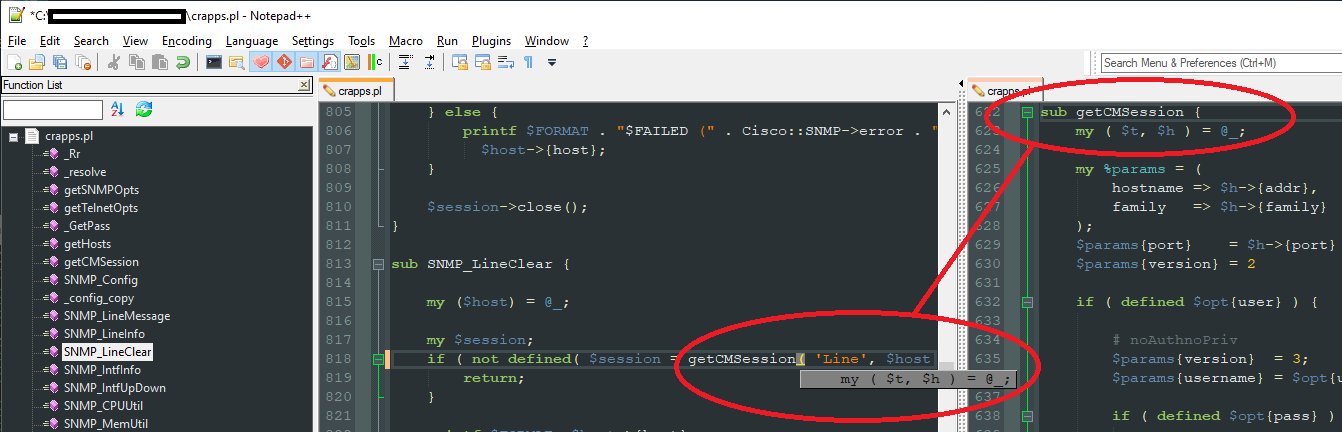
-
This post is deleted! -
@Ekopalypse said in Perl subroutine calltips - with PythonScript:
Can you try
from ctypes import CDLL, POINTER, c_int, c_char_p

perllib = CDLL(r'C:\Strawberry\perl\bin\perl524.dll')

["-le", "use Win32::Mechanize::NotepadPlusPlus qw/:main/; notepad->newFile();"]

perllib.RunPerl.restype = c_int
perllib.RunPerl.argtypes = c_int, POINTER(c_char_p), POINTER(c_char_p)
args = (c_char_p * 2)(b"-le", b"use Win32::Mechanize::NotepadPlusPlus qw/:main/; notepad->newFile();")
print(perllib.RunPerl(len(args),args, None))
It just prints
9in the PythonScript console. No new tab is opened. If I run the command itself from a prompt:C:\ > perl -e "use Win32::Mechanize::NotepadPlusPlus qw/:main/; notepad->newFile();"I get a new tab in Notepad++ as expected.
At least if it printed
42we’d know we’re on to something …Cheers.
-
Ja, 42 would be nice :-)
So 9 seems to be an error code. -
Can you try one more thing?
Replace the RunPerl call with this
print(perllib.RunPerl(len(args), args, (c_char_p * 1)(b'')))
With the newFile code, please. -
Same 9.
I tried both:
from ctypes import CDLL, POINTER, c_int, c_char_p

perllib = CDLL(r'C:\Strawberry\perl\bin\perl524.dll')

["-e", "use Win32::Mechanize::NotepadPlusPlus qw/:main/; notepad->newFile();"]

perllib.RunPerl.restype = c_int
perllib.RunPerl.argtypes = c_int, POINTER(c_char_p), POINTER(c_char_p)
args = (c_char_p * 2)(b"-e", b"use Win32::Mechanize::NotepadPlusPlus qw/:main/; notepad->newFile();")
print(perllib.RunPerl(len(args),args,(c_char_p * 1)(b"use Win32::Mechanize::NotepadPlusPlus qw/:main/; notepad->newFile();")))
and
from ctypes import CDLL, POINTER, c_int, c_char_p

perllib = CDLL(r'C:\Strawberry\perl\bin\perl524.dll')

["-e", "use Win32::Mechanize::NotepadPlusPlus qw/:main/; notepad->newFile();"]

perllib.RunPerl.restype = c_int
perllib.RunPerl.argtypes = c_int, POINTER(c_char_p), POINTER(c_char_p)
args = (c_char_p * 2)(b"-e", b"use Win32::Mechanize::NotepadPlusPlus qw/:main/; notepad->newFile();")
print(perllib.RunPerl(len(args),args,(c_char_p * 1)(b'')))
HOWEVER … this:
from ctypes import CDLL, POINTER, c_int, c_char_p

perllib = CDLL(r'C:\Strawberry\perl\bin\perl524.dll')

["use Win32::Mechanize::NotepadPlusPlus qw/:main/; notepad->newFile();"]

perllib.RunPerl.restype = c_int
perllib.RunPerl.argtypes = c_int, POINTER(c_char_p), POINTER(c_char_p)
args = (c_char_p * 1)(b"use Win32::Mechanize::NotepadPlusPlus qw/:main/; notepad->newFile();")
print(perllib.RunPerl(len(args),args,None))
produces
0in the PythonScript console.Cheers.
-
Ok, I should have installed strawberry perl in first place, solved all my issues.
First success
from ctypes import CDLL, POINTER, c_int, c_char_p

perllib = CDLL(r'D:\strawberry\perl\bin\perl532.dll')

perllib.RunPerl.restype = c_int
perllib.RunPerl.argtypes = c_int, POINTER(c_char_p), POINTER(c_char_p)

__args = [b"",
          b"-le",
          b"use Win32::Mechanize::NotepadPlusPlus qw/:main/; notepad->newFile();"]

args = (c_char_p * len(__args))(*__args)
x = perllib.RunPerl(len(args), args, None)
print(x)
This works, but only one time. A second call results in a
OSError: exception: access violation writing 0x0000000000000024Seems some cleanup needs to be done afterwards.
-
@Ekopalypse said in Perl subroutine calltips - with PythonScript:
Seems some cleanup needs to be done afterwards.
Yes, in my late night Google-ing I saw lots of references to
free(args)after theRunPerl()call.Examples:
https://comp.lang.perl.misc.narkive.com/r7M6eENL/dll-unload-question-for-embedded-perl-on-windows
https://www.nntp.perl.org/group/perl.wxperl.users/2017/01/msg9715.htmlCheers.
-
@Ekopalypse said in Perl subroutine calltips - with PythonScript:
__args = [b"",…Weird. If I don’t have the empty zeroth argument, the call fails (x==9). I wonder why it needs the blank argument…
-
@PeterJones said in Perl subroutine calltips - with PythonScript:
I wonder why it needs the blank argument…
I read some stuff on Par::Packer and it seems the first argument may be the optional path to the
perlexecutable.https://oliverbetz.de/pages/Artikel/Portable-Perl-Applications
Cheers.
-
Hmm … it looks like freeing the interpreter is the issue.
I tried to replicate what RunPerl is doing and when I use thisfrom ctypes import CDLL, POINTER, c_int, c_char_p, c_void_p, byref perllib = CDLL(r'D:\strawberry\perl\bin\perl532.dll') # perllib.RunPerl.restype = c_int # perllib.RunPerl.argtypes = [c_int, POINTER(c_char_p), POINTER(c_char_p)] # Perl_sys_init3(int* argc, char*** argv, char*** env) perllib.Perl_sys_init3.argtypes = [POINTER(c_int), POINTER(POINTER(c_char_p)), POINTER(POINTER(c_char_p))] # PerlInterpreter * perl_alloc(void) perllib.perl_alloc.restype = c_void_p perllib.perl_alloc.argtypes = [] # void perl_construct(pTHXx) perllib.perl_construct.argtypes = [c_void_p] # int perl_parse(pTHXx_ XSINIT_t xsinit, int argc, char **argv, char **env) # only 4 params ?? perllib.perl_parse.restype = c_int perllib.perl_parse.argtypes = [c_void_p, c_void_p, c_int, POINTER(c_char_p), POINTER(c_char_p)] # we need 5 params according to RunPerl # int perl_run(pTHXx) perllib.perl_run.restype = c_int perllib.perl_run.argtypes = [c_void_p] __args = [b"", b"D:\\scripts\\perl\\1.pl" ] # ******************************** content of 1.pl ******************************** # use strict; # use warnings; # my $timestamp = localtime(time); # sub logit { # my $message = shift; # my $filename = 'D:/report.txt'; # open(my $fh, '>>', $filename) or die "Could not open file '$filename' $!"; # print $fh $timestamp, " $message\n"; # close $fh; # } # logit("test"); # ********************************************************************************** args = (c_char_p * len(__args))(*__args) perllib.Perl_sys_init3(byref(c_int(len(args))), None, None) my_perl = perllib.perl_alloc() perllib.perl_construct(my_perl) result = perllib.perl_parse(my_perl, None, len(args), args, None) print('perl_parse', result) result = perllib.perl_run(my_perl) print('perl_run', result) print(open(r'D:\report.txt', 'r').read())I can run 1.pl multiple times
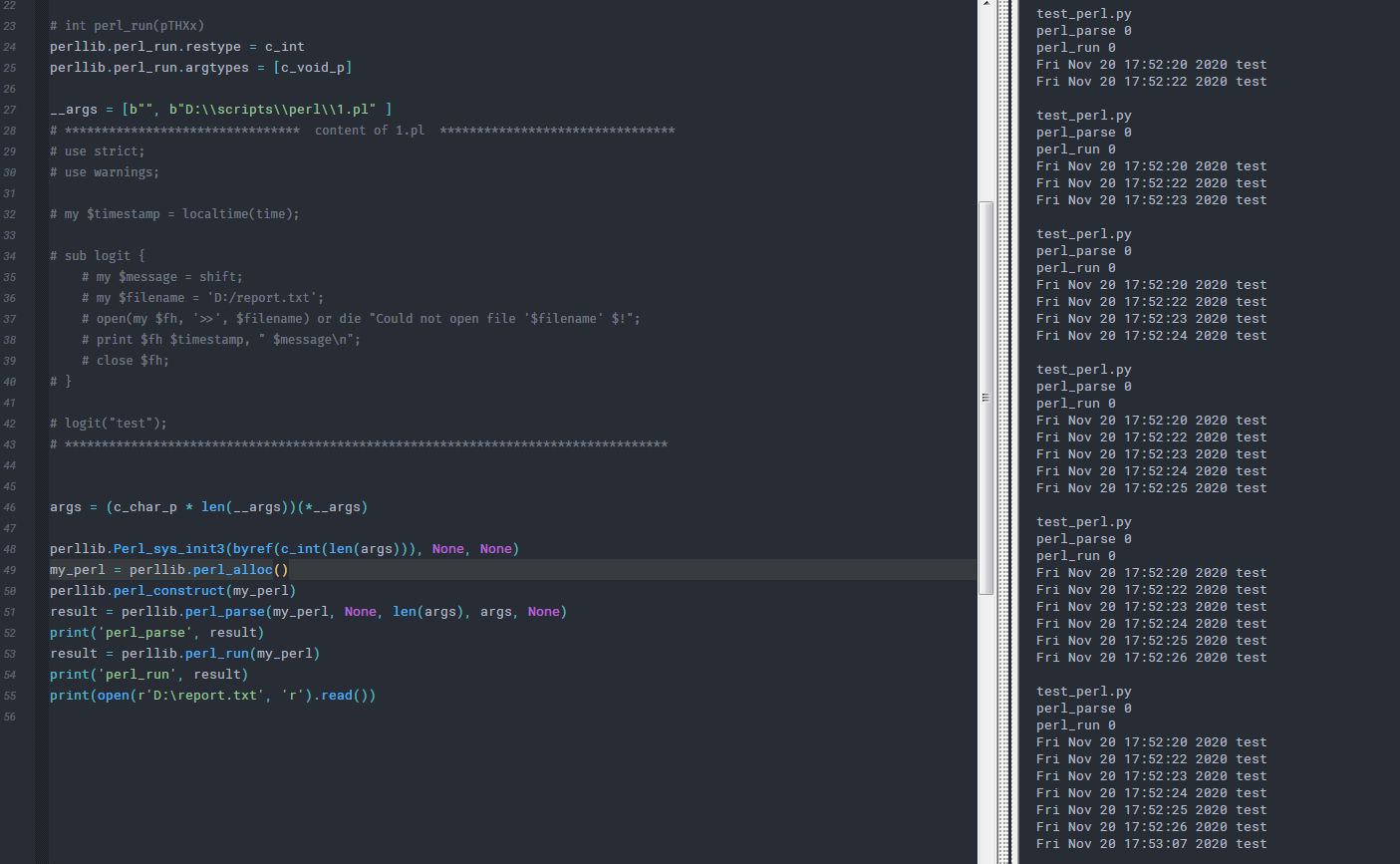
-
I guess I have a working “embedded” perl instance.
from ctypes import CDLL, POINTER, c_int, c_char_p, c_void_p, byref

perllib = CDLL(r'D:\strawberry\perl\bin\perl532.dll')

# Perl_sys_init3(int* argc, char*** argv, char*** env)
perllib.Perl_sys_init3.argtypes = [POINTER(c_int), POINTER(POINTER(c_char_p)), POINTER(POINTER(c_char_p))]

# PerlInterpreter * perl_alloc(void)
perllib.perl_alloc.restype = c_void_p
perllib.perl_alloc.argtypes = []

# void perl_construct(pTHXx)
perllib.perl_construct.argtypes = [c_void_p]

# int perl_parse(pTHXx_ XSINIT_t xsinit, int argc, char **argv, char **env)  # only 4 params ??
perllib.perl_parse.restype = c_int
perllib.perl_parse.argtypes = [c_void_p, c_void_p, c_int, POINTER(c_char_p), POINTER(c_char_p)]  # we need 5 params according to RunPerl

# int perl_run(pTHXx)
perllib.perl_run.restype = c_int
perllib.perl_run.argtypes = [c_void_p]

# int perl_destruct(pTHXx)
perllib.perl_destruct.restype = c_int
perllib.perl_destruct.argtypes = [c_void_p]

# SV* Perl_eval_pv(pTHX_ const char *p, I32 croak_on_error)
perllib.Perl_eval_pv.restype = c_void_p
perllib.Perl_eval_pv.argtypes = [c_void_p, c_char_p, c_int]

# # SV * Perl_sv_pv(pTHX_ const IV i)
perllib.Perl_sv_pv.restype = c_char_p
perllib.Perl_sv_pv.argtypes = [c_void_p, c_void_p]


__args = [b"", b"-e", b"0"]  # test_npp
args = (c_char_p * len(__args))(*__args)

perllib.Perl_sys_init3(byref(c_int(len(args))), None, None)
my_perl = perllib.perl_alloc()
perllib.perl_construct(my_perl)
if perllib.perl_parse(my_perl, None, len(args), args, None) == 0:
    for perlcode in [b"reverse 'rekcaH lreP rehtonA tsuJ'", b"$a = 3; $a **= 2", b"$a = 3; $a **= "]:
        val = perllib.Perl_eval_pv(my_perl, c_char_p(perlcode), 0)
        print(perllib.Perl_sv_pv(my_perl, val))
else:
    print('Perl interpreter setup error.')

print(perllib.perl_destruct(my_perl))
Next step would be to identify errors (see last example code)
and make additional modules working. I assume this has something
to do with the @INC …
and of course make a class out of it for easy reuse. -
I guess I have a working solution.
I’m afraid, it works, currently, only with PythonScript version 3.x
There is one open point, see TODO, which I can’t seem to find a solution for.from ctypes import CDLL, POINTER, c_int, c_char_p, c_void_p, byref, CFUNCTYPE from Npp import console perllib = CDLL(r'D:\strawberry\perl\bin\perl532.dll') # Perl_sys_init3(int* argc, char*** argv, char*** env) Perl_sys_init3 = perllib.Perl_sys_init3 Perl_sys_init3.argtypes = [POINTER(c_int), POINTER(POINTER(c_char_p)), POINTER(POINTER(c_char_p))] # PerlInterpreter * perl_alloc(void) perl_alloc = perllib.perl_alloc perl_alloc.restype = c_void_p perl_alloc.argtypes = [] # void perl_construct(pTHXx) perl_construct = perllib.perl_construct perl_construct.argtypes = [c_void_p] # int perl_parse(pTHXx_ XSINIT_t xsinit, int argc, char **argv, char **env) # only 4 params but pTHXx_ is a macro resulting in 5 params xsinit = CFUNCTYPE(None, c_void_p) perl_parse = perllib.perl_parse perl_parse.restype = c_int perl_parse.argtypes = [c_void_p, xsinit, c_int, POINTER(c_char_p), POINTER(c_char_p)] # int perl_run(pTHXx) perl_run = perllib.perl_run perl_run.restype = c_int perl_run.argtypes = [c_void_p] # int perl_destruct(pTHXx) perl_destruct = perllib.perl_destruct perl_destruct.restype = c_int perl_destruct.argtypes = [c_void_p] # SV* Perl_eval_pv(pTHX_ const char *p, I32 croak_on_error) Perl_eval_pv = perllib.Perl_eval_pv Perl_eval_pv.restype = c_void_p Perl_eval_pv.argtypes = [c_void_p, c_char_p, c_int] # SV * Perl_sv_pv(pTHX_ const IV i) Perl_sv_pv = perllib.Perl_sv_pv Perl_sv_pv.restype = c_char_p Perl_sv_pv.argtypes = [c_void_p, c_void_p] # SV * Perl_sv_string_from_errnum(pTHX_ int errnum, SV *tgtsv) Perl_sv_string_from_errnum = perllib.Perl_sv_string_from_errnum Perl_sv_string_from_errnum.restype = c_void_p Perl_sv_string_from_errnum.argtypes = [c_void_p, c_int, c_void_p] # SV* Perl_get_sv(pTHX_ const char *name, I32 flags) Perl_get_sv = perllib.Perl_get_sv Perl_get_sv.restype = c_void_p Perl_get_sv.argtypes = [c_void_p, c_char_p, c_int] # void boot_DynaLoader (pTHX_ CV* cv) boot_DynaLoader = perllib.boot_DynaLoader boot_DynaLoader.argtypes = [c_void_p, c_char_p] # Perl_newXS(pTHX_ const char *name, XSUBADDR_t subaddr, const char *filename) Perl_newXS = perllib.Perl_newXS Perl_newXS.argtypes = [c_void_p, c_char_p, c_void_p, c_char_p] class PerlInterpreter: def __init__(self): Perl_sys_init3(byref(c_int(3)), None, None) @staticmethod def call(perlcode): # TODO: https://perldoc.perl.org/perlembed#Maintaining-a-persistent-interpreter # PL_exit_flags |= 0x2 # PERL_EXIT_DESTRUCT_END # I assume, that this would avoid calling alloc, construct and parse over and over again. # but how can we set it, seems not to be exported. # Following code fails: ValueError: symbol 'PL_exit_flags' not found # exit_flags = c_int.in_dll(perllib, 'PL_exit_flags') # exit_flags.value |= 2 my_perl = perl_alloc() perl_construct(my_perl) def xs_init(pTHX): # https://perldoc.perl.org/perlembed#Using-Perl-modules,-which-themselves-use-C-libraries,-from-your-C-program Perl_newXS(pTHX, b"DynaLoader::boot_DynaLoader", boot_DynaLoader, b'__FILE__' # Seems to work, but ... ?? ) res = perl_parse(my_perl, xsinit(xs_init), 3, (c_char_p * 3)(*[b"", b"-e", b"0"]), None) if res != 0: _error = Perl_sv_pv(my_perl, Perl_sv_string_from_errnum(my_perl, res, None)) perl_destruct(my_perl) raise(RuntimeError(f'Perl interpreter setup error. {_error.decode()}')) result = Perl_sv_pv(my_perl, Perl_eval_pv(my_perl, c_char_p(perlcode.encode()), 0)) error = Perl_sv_pv(my_perl, Perl_get_sv(my_perl, "@".encode(), 0)).decode() perl_destruct(my_perl) return error, result.decode() if __name__ == '__main__': perl = PerlInterpreter() for perlcode in [ "use Win32::Mechanize::NotepadPlusPlus qw/:main/; notepad->newFile();", "reverse 'rekcaH lreP rehtonA tsuJ'", "$a = 3; $a **= 2", "$a = 3; $a **= ", ]: error, result = perl.call(perlcode) if error: console.writeError(error+'\n') else: print(result) -
@Ekopalypse said in Perl subroutine calltips - with PythonScript:
I’m afraid, it works, currently, only with PythonScript version 3.x
And maybe “newer” Perl as well. I’m on Strawberry 5.24 and get this:
Traceback (most recent call last):
  File "C:\usr\bin\npp64\plugins\PythonScript\scripts\EmbeddedPerl.py", line 46, in <module>
    Perl_sv_string_from_errnum = perllib.Perl_sv_string_from_errnum
  File "C:\usr\bin\npp64\plugins\PythonScript\lib\ctypes\__init__.py", line 386, in __getattr__
    func = self.__getitem__(name)
  File "C:\usr\bin\npp64\plugins\PythonScript\lib\ctypes\__init__.py", line 391, in __getitem__
    func = self._FuncPtr((name_or_ordinal, self))
AttributeError: function 'Perl_sv_string_from_errnum' not found
I don’t want to sound ungrateful - what you’ve done is amazing, just thought you should know.
Cheers.
-
Thx for testing. I think I’m using the newer version, mine is called 5.32.
Any thoughts on what a reasonable version to start with might be? -
according to git this api function was introduced in 2017
658db62260a (Zefram 2017-08-13 01:59:43 +0100 689) #define sv_string_from_errnum(a,b) Perl_sv_string_from_errnum(aTHX_ a,b)but 5.24 has been released on May 8, 2016
-
Just to make clear, this function is not really needed.
It just provides a textual description of an error number.
One can comment# _error = Perl_sv_pv(my_perl, # Perl_sv_string_from_errnum(my_perl, res, None))and change the runtime raise to
raise(RuntimeError(f'Perl interpreter setup error. {res}'))and it should work. Hopefully.
-
@Ekopalypse said in Perl subroutine calltips - with PythonScript:
Just to make clear, this function is not really needed.
That worked!



Hello! It looks like you're interested in this conversation, but you don't have an account yet.
Getting fed up of having to scroll through the same posts each visit? When you register for an account, you'll always come back to exactly where you were before, and choose to be notified of new replies (either via email, or push notification). You'll also be able to save bookmarks and upvote posts to show your appreciation to other community members.
With your input, this post could be even better 💗
Register Login