Search++: A work in progress
-
But, even though I unckecked, both, the
Default commands automatically search within selectionsand theDefault commands automatically search within marked textoptions and valid the new settings with theOKbutton, after selected some text containing ONLY one occurrence of the search, theCount in Selectionstill give1match only and not the totality of the matches of the current fileThen, using the
Add Selection to Marked Textoption to mark all the selection raange (Ctrl + M), again, theCount in Marked Textreturns1match, instead of the totality of the matches. Is this expected or a bug as the scope should beWhole Document?The Default commands automatically… settings only affect commands with default scope. What happens when you uncheck one or both of those settings is that the commands with default scope:
Find
Find Backward
Count
Find All
Select
Mark
Show
Replace
Replace Backward
Replace All
pay no attention to whether there is a selection (if …within selections is unchecked) and/or marked text (if …within marked text is unchecked), and just search the whole document.Commands that specify a scope, like Count in Selection or Count in Marked Text, still do what their name says they do.
-
What prompted me to suggest another solution is that you seemed really frustrated with how your plugin works,
I do appreciate your suggestions, even if I don’t immediately adopt them as written. Anything you can tell me that sheds light on your experience with the interface and how it seems like it should work can help me find new solutions.
Anyway, as you said, menus seem preferable. However, I still think that a layout with the six buttons Find, Count, Find All, Select, Mark and Show could be easier to use ( Personally, I’m ready to test a forked version, if you think it’s worth it )
This would simplify the number of menus :
I can see how splitting the Find All button into four buttons (one each for Find All, Select, Mark and Show) would make the interface simpler, in that it would get rid of the need for sub-menus on those buttons. (And as you’ve pointed out, the [Do not] Jump to next match sub-menu on Replace isn’t really needed.) I’m not convinced yet, but it’s not out of the question, either.
My “default scope” (or “adaptive scope”) notion is a kind of extension of Notepad++’s Settings | Preferences | Searching | Minimum Size for Auto-Checking “In selection”. Since the docking version of the Search++ dialog might rarely if ever be closed and reopened during a session (I leave it open all the time), just choosing the setting when the dialog opens wouldn’t be much help: I wanted something that adapts to changing conditions, but that the user can still override when necessary. And I wanted it to handle selections and marked text similarly. It’s meant to make it so that usually you can just click a button and have it do what you would want it to do.
-
Hello, @coises,
You said :
What happens when you uncheck one or both of those settings is that the commands with default scope:
and :
Commands that specify a scope, like Count in Selection or Count in Marked Text, still do what their name says they do.
Thus, before downloading your new
Search++ version 0.7release, I ran a few more tests, and honestly, I was wrong about that. It’s kind of like I’m rediscovering the true concept of yourdefault scope!!So when, BOTH, the
Default commands automatically search within selectionsand theDefault commands automatically search within marked textoptions are unchecked, in Settings :-
The default
Findaction is identical to theFind in Whole documentaction -
The default
Countaction is identical to theCount in Whole documentaction -
The default
Find allaction is identical to theFind All in Whole Documentaction -
The default
Selectaction is identical to theSelect in Whole Documentaction -
The default
Markaction is identical to theMark in Whole Documentaction -
The default
Showaction is identical to theShow in Whole Documentaction -
The default
Replaceaction is identical to theReplace in Whole Documentaction -
The default
Replace allaction is identical to theReplace All in Whole Documentaction
Now, many thanks, @coises, for this new release ! Indeed, the
Showfeature has been completely redesigned and the addition of a separate style, different from theMarkfeature is a good improvement !However, I needed some time to understand what meant the option
Show selected lines (Shift: All) Ctrl + Q, in theToolsdialog ! Luckily, with theSearch++documentation, I understood the difference betweenCtrl + QandCtrl + Shift + QWould it be more simple to write the two lines :
Show selected lines          Ctrl + Q

Show all lines               Ctrl + Shift + Q
Instead of that single line ( which sometimes seems wrongly labelled
Show all lines Ctrl + Q )?!
Your new
Expand visible Ctrl P, in theToolsmenu, is really a nice feature. I would suggest to label this optionShow one more line before and afteras this command can be repeated !BTW, do you plan to add, in the future, such a feature to the
Find Allfunctionality ?
Now, let’s say that I marked
15occurrences of some text. As I checked theBookmark lines when marking textoption, I got15blue marks. If I use your newInvert marked text, all non-marked text get marked and all marked text becomes unmarked : OKHowever, the bookmarks do NOT follow this new marked text. In addition, may be the option
Invert marked Lineswould be more interesting ! Or, possibly, the two options ?Best Regards,
guy038
-
-
It’s kind of like I’m rediscovering the true concept of your
default scope!!Your observations are correct. I think you get how it works now… which leaves me with the problem: How do I make this obvious to users who are not going to spend nearly as much time as you have spent to understand it?
Perhaps you see why I think it is useful: not having to constantly use a menu (or a dialog) for routine things like searching in a selection, or marking text and then finding or replacing within the marked text. Also, the Settings allow users to customize it to the way they work most often.
Yet, it loses its usefulness if it is a puzzle to know when it will do what, and you have to use the drop-down anyway because you aren’t sure what the default command will do. I’m still working toward finding a design that is efficient for power users, obvious for casual users, and predictable for everyone, while remaining visually appealing.
However, I needed some time to understand what meant the option
Show selected lines (Shift: All) Ctrl + Q, in theToolsdialog ! Luckily, with theSearch++documentation, I understood the difference betweenCtrl + QandCtrl + Shift + QWould it be more simple to write the two lines :
Show selected lines          Ctrl + Q

Show all lines               Ctrl + Shift + Q
Instead of that single line ( which sometimes seems wrongly labelled
Show all lines Ctrl + Q )?!Without going into a lot of details, it comes down to economy of underlined letters for the menu options. (I’m reserving S, and the keyboard combination Ctrl+S, for save search.)
The menu option is labeled Show all lines when the selection (or caret if nothing is selected) occupies only lines that are already visible. In this case, there is no need to require Shift to show all lines, since showing selected lines would do nothing. It is labeled Show selected lines (Shift: all) when the selection includes text on a hidden line; then without Shift the command shows the selected line, but if you really wanted to show all lines, you can press Shift when you click to do that.
Mark selected text and Mark shown text have a similar dual function. If any text is already marked, they show (Shift: clear first) in the menu item. Using Shift clears existing marks first, while not using Shift adds to the existing marks.
All of these have keyboard accelerators using the same letter with and without the Shift key, which duplicate the functions of the menu commands.
Your new
Expand visible Ctrl P, in theToolsmenu, is really a nice feature. I would suggest to label this optionShow one more line before and afteras this command can be repeated !(It might seem silly, but running out of letters, I spent some time thinking of a way to use “p” before I came up with “Expand” for this option. “P” was one of the few letters that was unused in both upper and lower case as a keyboard accelerator, and I plan to add a (Shift: details) option, or something similar, allowing the user to do multiple lines at a time, or different numbers of lines before and after, or perhaps something else… I haven’t decided.)
BTW, do you plan to add, in the future, such a feature to the
Find Allfunctionality ?I hope to do that, but unlike Show, I expect that it will be necessary to specify the amount of context to be shown before and after each match before executing the Find All command.
Now, let’s say that I marked
15occurrences of some text. As I checked theBookmark lines when marking textoption, I got15blue marks. If I use your newInvert marked text, all non-marked text get marked and all marked text becomes unmarked : OKHowever, the bookmarks do NOT follow this new marked text. In addition, may be the option
Invert marked Lineswould be more interesting ! Or, possibly, the two options ?I’ve been a little uncertain how to handle bookmarks. I don’t generally use bookmarks in Notepad++ at all, so I don’t have much sense of how people use them.
I suppose that when Bookmark lines when marking text is checked, bookmarks should follow marks. But what if you already had some bookmarks, and then you added some more when marking text. Then you do something like Invert marked lines because you want to search for something in the remaining text — are you likely to accidentally lose bookmarks you set because you forgot to turn off Bookmark lines when marking text first? (Strictly speaking, you wouldn’t lose them, but they’d be mixed in with all the other previously unmarked lines, so in effect they would be lost.)
What do you think? My thought was that the reasonable use case for Invert marked text is to restrict a search to what wasn’t found in a previous search, and that carrying bookmarks along would be more likely to be an oversight than something you wanted to do.
-
Hi, @coises and All,
You said :
I’m still working toward finding a design that is efficient for power users, obvious for casual users, and predictable for everyone, while remaining visually appealing.
Good luck in the quest for this Holy Grail !!!
Now, is the following behavior a bug:
-
I previously checked the
Bookmark lines when marked textin theToolsmenu -
Then I do a simple selection of some lines of text
-
I use the
Mark selected textoption ( orCtrl + M)
=> Only the first line of the selection is bookmarked ( instead of each line of the selection ). It’s also the case if the file contains previous marked text and if I use the
Ctrl + Shift + Moption
You said :
(It might seem silly, but running out of letters, I spent some time thinking of a way to use “p” before I came up with “Expand” for this option. “P” was one of the few letters that was unused in both upper and lower case …
OK. So, perhaps you’ll agree with this new wording
Expand to one more line before and after, waiting for theShift(details)option. Allow me to proposeExpand to five lines before and after Ctrl + Shift + P. This would be a good compromise !
You said :
I’ve been a little uncertain how to handle bookmarks. I don’t generally use bookmarks in Notepad++ at all, so I don’t have much sense of how people use them.
Unlike you, I use bookmarks very OFTEN to isolate or delete portions of text. After marking some text, I mainly use the context menu by right-clicking within the bookmarks margin. For example :
-
I mark and bookmark sone lines of text for a specific occurrence. Then I copy all these lines and paste them in a new tab for further review
-
I mark and bookmark sone lines of text for a specific occurrence. Then I can either delete them or delete the non-bookmarked lines
-
I mark and bookmark sone lines of text for a specific occurrence. Then I cut them and paste all these bookmarked lines in an other location of the same file
-
After a sort, I mark and bookmark the duplicate lines of a file. Then I have two possibilities :
-
I delete all the bookmarked lines in order to keep only the unique lines
-
I invert the bookmarked lines and copy the unique lines in a new tab for further review
-
There’s just one option that I rarely use : the
Paste to (Replace) Bookmarked Lineswhich replaces each bookmarked line by the contents of the Clipboard !
There’s one thing that bothers me about your Invert marked text option :
- Let’s imagine the text, below, pasted in a new tab :
bla blah This is the test to do bla blah test bla blah-
Select the N++
Show All Charactersoption -
Mark, with
Search++, the two wordstest -
Now, use the option
Invert marked text:-
The first line of the file is wrongly bookmarked ( bug ? )
-
The two line-breaks, after each word
test, are also bookmarked
-
Compare by pasting the above text in a second tab, use the native N++
Markcommand and then theInvert Bookmarksoption of the Bookmark margin context menu ( In fact, anInvert Bookmarked Linesoption ).Thus, I think that you should add the
Invert bookmark linesoption, in theToolsdialog. Then :-
By using the
Invert bookmarked textoption, the results would be the SAME as they are now ! And the present bookmarks would remain as is. -
By using the
Invert bookmark lines Ctrl + Shift + L, the bookmarked lines would be inverted, but the marked text would remain as is, like with native N++ !
Best Regards,
guy038
-
-
Now, is the following behavior a bug:
-
I previously checked the
Bookmark lines when marked textin theToolsmenu -
Then I do a simple selection of some lines of text
-
I use the
Mark selected textoption ( orCtrl + M)
=> Only the first line of the selection is bookmarked ( instead of each line of the selection ). It’s also the case if the file contains previous marked text and if I use the
Ctrl + Shift + MoptionUnlike you, I use bookmarks very OFTEN to isolate or delete portions of text. After marking some text, I mainly use the context* menu by right-clicking within the bookmarks margin. For example :
-
I mark and bookmark sone lines of text for a specific occurrence. Then I copy all these lines and paste them in a new tab for further review
-
I mark and bookmark sone lines of text for a specific occurrence. Then I can either delete them or delete the non-bookmarked lines
-
I mark and bookmark sone lines of text for a specific occurrence. Then I cut them and paste all these bookmarked lines in an other location of the same file
-
After a sort, I mark and bookmark the duplicate lines of a file. Then I have two possibilities :
-
I delete all the bookmarked lines in order to keep only the unique lines
-
I invert the bookmarked lines and copy the unique lines in a new tab for further review
-
Thank you for these observations and clarifications. I see that I have misunderstood how bookmarks are used.
I had assumed the purpose of a bookmark was to make it possible to scroll quickly to locations you expect to want to find again (like putting a bookmark in a physical book). What you wrote tells me they are (also?) used as a way of marking whole lines to be processed differently from the remaining lines.
I added the Bookmark lines when marking text option when it was requested. (I think you requested it, and maybe someone else, too.) I see now that I didn’t implement that request correctly, or at least not the way Notepad++ does it. When marking matches that span multiple lines, Notepad++ puts a bookmark on every line involved in each match. In Search++, only the line where each match starts is bookmarked.
That came from my misunderstanding, thinking the only purpose of bookmarks was to find something easily. Since I thought that was how bookmarks were used, I kept the same idea when marking a selection: Search++ bookmarks only the first line (or the first line of each part of a multiple selection).
(Adding to the confusion, I forgot what was in my own code when I answered you about Invert marked text. I gave an explanation of why it doesn’t change bookmarks; but it does change bookmarks when Bookmark lines when marking text is checked. It clears all bookmarks and then puts a bookmark at the beginning of each contiguous span of marked text. That does exactly what I argued in my last post should not happen: it loses any individual bookmarks you might have set apart from those set by marking text.)
I will need to reconsider everything I do with bookmarks.
Some questions, not just for Guy but for anyone who uses bookmarks:
Is marking lines for processing, the way Guy describes, pretty much the only way people use bookmarks?
Or do you also (or instead) use bookmarks for navigation?
Is optimal behavior for the two uses different (e.g., bookmarking all lines that are part of a match, as Notepad++ does, versus marking only the beginning of a match, as Search++ does now)?
If you use “bookmark lines” when marking text (either in Notepad++ or Search++), is that a way of working in which you expect bookmarks to follow marked text? Or do you specifically want the search process to bookmark lines, but otherwise think of bookmarks and marked text as independent things?
-
-
Is marking lines for processing, the way Guy describes, pretty much the only way people use bookmarks?
Or do you also (or instead) use bookmarks for navigation?
Me personally, I almost never “bookmark” from the Mark dialog. I bookmark a line from the GUI (clicking in the margin) when I want to be able to navigate there when doing related edits in two or three different sections of code. But that’s my usage.
I know I’ve seen lots of posts here where people like using the bookmarks – especially across multiple lines – to make use of the Search > Bookmark > xxx Bookmarked Lines , and that’s often given as advice for some of the convoluted search needs that come up here.
So making sure it works under both use cases is probably a good idea.
-
Or do you specifically want the search process to bookmark lines, but otherwise think of bookmarks and marked text as independent things?
I make use of bookmarks because they are saved in sessions. Marks and changed line indicators are not. I mark some things with bookmarks, turn mark with bookmarks off, clear marks, do stuff … mark some other things with bookmarks, save session. Then I can use bookmarks later to review the areas I have been looking at.
-
Hello, @coises, @peterjones, @astewart77 and All,
Of course, regarding my bookmarks’s use, I also, very often use them, as described by @peterjones, to easily reach specific locations, in current file which, indeed, are kept from current session to the next one, as long as you keep this current file opened in the current session and that you close and restart Notepad++, in order to save these bookmarked lines in
session.xmlfile !In addition, when I marked all the occurrences of a specific search, it’s quite easy to navigate between them, using the
F2andShift + F2shortcut to reach the next / previous bookmarked line ! Once again, you’ll need to close and restart N++ => All the bookmarks of the previous search are kept but, of course, the REDMarkstyle of each occurrence has now disappeared !BR
guy038
-
@peterjones, @astewart77, @guy038 and anyone else who cares to comment,
I’m working on an experimental release with a customizable way to handle bookmarks when marking, but I won’t have it ready tonight. In the meantime, another question:
The Mark command cannot mark null matches (regular expressions when they match zero characters, at a particular position).¹ When Bookmark lines when marking text is checked, should lines in which null matches occur still be bookmarked, even though they can’t be marked?
Or is it more important that marks and bookmarks “match”?
Or is this something that needs to be an option?
¹ There is no way to mark a position, as opposed to a character, in Scintilla. Show gets around that (with limitations) for null matches by using a second indicator which marks the character following the position using a Scintilla indicator with INDIC_POINT style. I think it would be too problematic to try to make marked text work with a similar second indicator, since marked text is used in other ways than just displaying.
-
should lines in which null matches occur still be bookmarked, even though they can’t be marked?
I would say a weak Yes. I probably made a mistake with a null match expression, and a bookmark next to an unmarked line is the flag for me to notice that useless result. The Found xxx matches (zz marked, yy null) would have me wondering where those yy lines are, if not for the bookmark.
-
Hi, @coises, @peterjones, @astewart77 and All,
As suggested by @astewart77, I also support the idea of adding a bookmark when searching for lines that match regular expressions of form :
^$^$.[0}
or similar ones !
BR
guy038
-
Search++ version 0.7.0.1 is a test of what is hopefully improved bookmark handling. Help and changelog have not been updated.
@guy038, @peterjones, @astewart77 and anyone else interested, please let me know if this lets you configure bookmark handling to your liking, and anything you would like to be different.
The Bookmark lines when marking text (Shift: configure) item on the Tools menu can be clicked to toggle whether marking adds bookmarks, just like before. Shift-clicking (or Ctrl+Shift+B) opens this dialog (defaults shown selected):
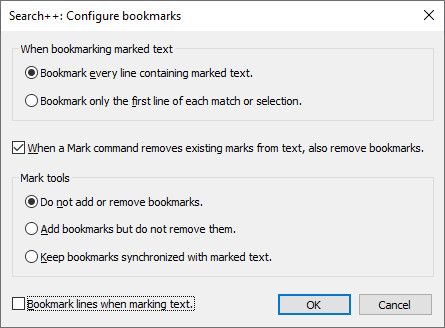
The Bookmark lines when marking text option at the bottom right is identical to the menu setting; it’s just in this dialog so you don’t have to open the menu a second time to see or change it. The other options in this dialog are only relevant when this box is checked; unchecking it, or the equivalent menu setting, keeps Search++ from doing anything with bookmarks, with one exception: the new Synchronize bookmarks to marked text command.
The first pair of radio buttons choose whether you want marking to put a bookmark on every marked line or only on the first line of a match (or of a selection, or of each part of a multiple selection, when you mark selections).
When a Mark command removes existing marks from text, also remove bookmarks applies in two contexts, and only when Bookmark lines when marking text is in effect:
-
When Settings | Always unmark all text before Mark command is checked, each Mark command “starts over,” removing any existing marks before it begins marking new matches. If this box is checked (the default), bookmarks are also cleared.
-
Regardless of the Always unmark… setting, Mark in Marked Text always removes existing marks before it begins marking new text (otherwise it could not do anything, since all the new marks would be within existing marks). If this box is checked (the default), bookmarks are also cleared.
The three choices under Mark tools apply to most commands on the Tools menu (exceptions noted below):
-
Do not add or remove bookmarks means Tools menu commands that mark or unmark text don’t do anything with bookmarks, even if Bookmark lines when marking text is checked.
-
Add bookmarks but do not remove them means just what it says: tools commands that mark text also add bookmarks (in accordance with the Bookmark every line or Bookmark only the first policy set in the top section of the dialog), but tools commands never remove them: you decide when to remove bookmarks.
-
Keep bookmarks synchronized with marked text means tools commands that mark or unmark text maintain bookmarks so that they are consistent with marked text in accordance with the Bookmark every line or Bookmark only the first policy set in the top section of the dialog.
Special cases:
-
Invert marked text does not add new markers if Add bookmarks but do not remove them is in effect (the results would be useless). If Keep bookmarks synchronized with marked text is in effect, the policy in the top section is followed.
-
When Bookmark lines when marking text is in effect, the dialog raised in response to Remove marks from multiple documents… contains a checkbox that determines whether or not bookmarks are cleared. The Mark tools setting on the Configure bookmarks dialog is ignored. When Bookmark lines when marking text is not in effect, the dialog does not offer the option to clear bookmarks.
-
The new Synchronize bookmarks to marked text command applies the policy selected for Bookmark every line containing marked text or Bookmark only the first line of each match or selection regardless of any other settings, including Bookmark lines when marking text. Since the locations of individual matches or selections before they were marked is unknown, this command treats each contiguous span of marked text as a single match/selection if Bookmark only the first line of each match or selection is in effect.
Also in this test release:
-
Some changes to make sure tools commands that would be disabled on the menu don’t do anything when run from a keyboard combination.
-
Leave bookmarks alone when converting selection to marks (Settings | Convert selections to marked text when beginning a default stepwise search) and when removing marks on closing the non-docking dialog (Settings | Unmark all text when closing the search dialog), regardless of any settings.
-
Make right-click equivalent to Shift+click in menus.
-
-
Hi, @coises,
Thanks for this test version, regarding bookmark handling !
However, it’s now a quarter past midnight, in France. So, see you tomorrow !
BR
guy038
-
It works well for me. There are so many permutations, it takes a couple of readings. I look forward to your excellent updated help file.
The three choices under Mark tools apply to most commands on the Tools menu
I suggest that the “Mark tools” option group title be “Tools menu” to be clear that they are for menu commands and not Mark commands, but that may be covered in the help file. Otherwise, it looks like it contradicts the Mark option just above it.
-
It works well for me. There are so many permutations, it takes a couple of readings. I look forward to your excellent updated help file.
Part of the point of this test version is to figure out if I have too many options, or missing options, or if they can be better organized. There are more details and special cases than I’d like. At the moment this might represent more what could be done than what should be done.
I suggest that the “Mark tools” option group title be “Tools menu” to be clear that they are for menu commands and not Mark commands, but that may be covered in the help file. Otherwise, it looks like it contradicts the Mark option just above it.
That’s a good point. Somehow it should be clear that this section applies to commands from the Tools menu (and, of course, to their equivalent keyboard shortcuts), but not to the Mark command itself. And I wonder if it is clear that it doesn’t apply when Bookmark lines when marking text isn’t checked. Making this obvious at first glance is not going so well. (I know most people are never going to read the help.)
Would the top section be better labeled “Bookmark policy,” or is that just more confusing? Or am I silly to even have the top section, and whenever bookmarks are enabled it should just always be bookmark every line (like Notepad++ native Mark)?
I’m similarly unsure if Add bookmarks but do not remove them is pointless. Maybe no one would ever want that.
Another question is whether all this belongs in yet another box in the Settings dialog rather than in its own “Configure bookmarks” dialog. Settings is getting big, but if these are “set once and leave them alone” choices, that’s probably where they belong. (I don’t mean the Bookmark lines when marking text menu option; that stays on the menu.)
-
Part of the point of this test version is to figure out if I have too many options
I can see a use for all of the options you have now.
I’m similarly unsure if Add bookmarks but do not remove them is pointless. Maybe no one would ever want that.
That’s the one option I selected right away. I like to accumulate bookmarks over time.
-
Hello, @coises,
Sorry, I haven’t commented on your latest version yet. In the meantime, I replied to @Vitalii-dovgan regarding his own implementation of the
Find in Filesfeature.During that testing, I also included the
Search++plugin ( v0.7 ) and theMultiReplaceplugin.So I invite you to take a look at it : https://community.notepad-plus-plus.org/post/106389
As for your latest version, I won’t be able to review it thoroughly until tomorrow evening. So, I’ll probaly get back to you on Saturday instead !
BR
guy038
-
Hello, @coises and All,
FIRST test. Let’s suppose I chose these settings :
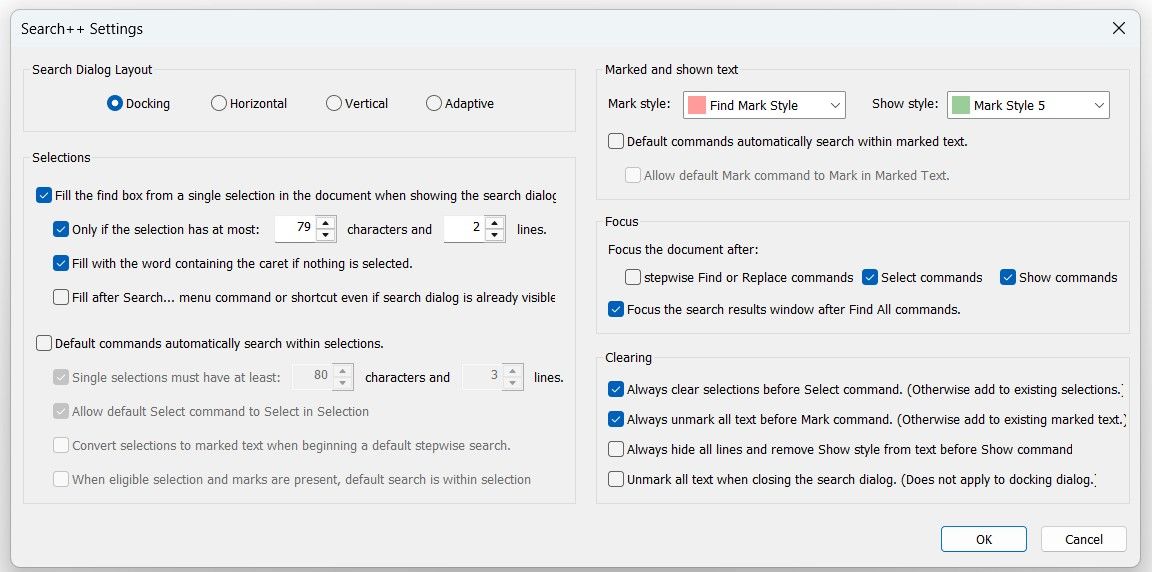
You note that I unchecked the two options
Default commands automatically search within selectionsandDefault commands automatically search within marked text. Thus, all default commands will always apply to whole documentNote also that I checked the two options
Always clear selections before Select command. (Otherwise add to existing selections.)and theAlways unmark all text before Mark command. (Otherwise add to existing marked text.)And that I decided to not bookmark the lines containing a marked text :
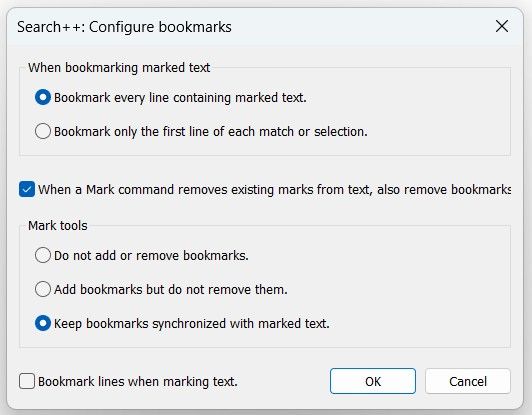
Then, starting with that text :
bla
blah
This is the test to do
bla
blah
test
bla
blah
I marked the two words
testwith theMarkcommand or theMkey. Now, given the above parameters, it just marked these two words.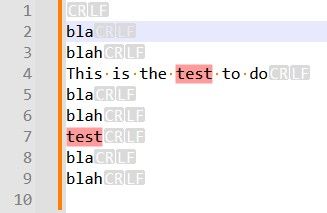
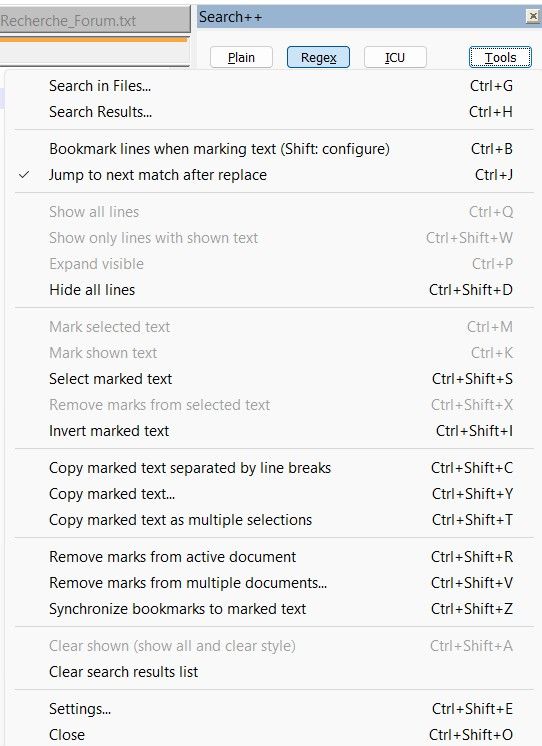
Then, using the
Synchronize bookmarks to marked textoption, ( Ctrl + Shift + Z ), it bookmarked the lines4and7=> OK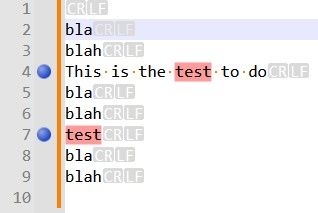
Now, using the
Remove marks from active documentoption ( Ctrl + Shift + R ), it deleted any marked text. However the bookmarks remain.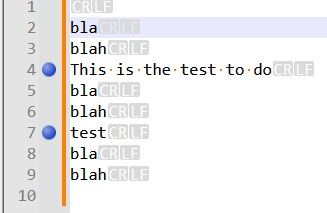
Is this behavior logical as you said that, even when the
Bookmark lines when marking textis not checked, theKeep bookmarks synchronized with marked textoption is still honored ?
SECOND test :
I now decided to check the
Bookmark lines when marking textoption ( Ctrl + B )Again, I marked the two words
testwith theMarkcommand or theMkey. Given the modified parameters, it correctly marked these two words and bookmarked the lines4and7Then using the
Remove marks and bookmarks from active documentoption ( Ctrl + Shift + R ), it deleted, both, marked text and bookmarks => OKRemark that this command is now labelled
Remove marks and bookmarks ..., unlikeRemove marks ...in the first test : nice !
THIRD test :
Again, I marked the two words with a
Markcommand. Thus, the snapshot below :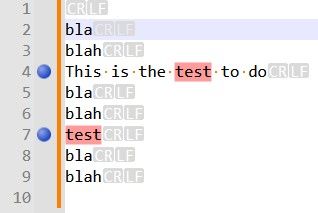
Then, I used the
Invert marked textoption ( Crl + Shift + I ). I got this snapshot :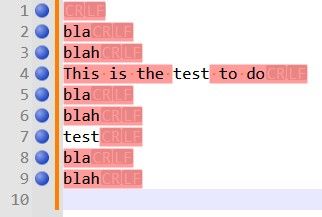
That’s not exactly what I expected !
I wanted to invert all the bookmarks, FIRST and SECONDLY, mark the contents of all the lines having a bookmark ! To do so, instead of searching the
testword, I needed to use the regex^((?!test).)*$and I chose again theMarkcommand to get this behavior. See below :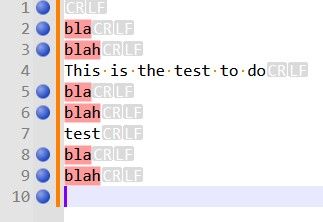
Note that this behavior is even better than with
N++. Indeed, if you decide to use theInvert bookmarksfeature, it swaps the bookmarks but leaves the marked text as is, in lines4and7!Of course, @coises, to imagine the negative regex
^((?!test).)*$compared to the positive regextestis easy enough with that simple example. However, how to quickly determine a correct negative regex vs a complicated positive regex ?
Of course, it’s obvious that your plugin is already very configurable and has numerous options ! So, may be, my request might not be reasonable !
BTW; I really appreciate the right click on any option. For example :
-
First, you right-click on the
Hde all linesoption ( Ctrl + Shift + D ) option => Any line of current document is hidden -
Then, if you right-click on the
Show selected lines (Shift: All)option => All lines of current document are visible again !
Best Regards,
guy038
-
-
Thank you for taking a look at this!
Now, using the
Remove marks from active documentoption ( Ctrl + Shift + R ), it deleted any marked text. However the bookmarks remain.Is this behavior logical as you said that, even when the
Bookmark lines when marking textis not checked, theKeep bookmarks synchronized with marked textoption is still honored ?It is behaving as designed, though the intent may be unclear. For the record, what I wrote was:
The Bookmark lines when marking text option at the bottom right is identical to the menu setting; it’s just in this dialog so you don’t have to open the menu a second time to see or change it. The other options in this dialog are only relevant when this box is checked; unchecking it, or the equivalent menu setting, keeps Search++ from doing anything with bookmarks, with one exception: the new Synchronize bookmarks to marked text command.
The new Synchronize bookmarks to marked text command applies the policy selected for Bookmark every line containing marked text or Bookmark only the first line of each match or selection regardless of any other settings, including Bookmark lines when marking text.
The Keep bookmarks synchronized with marked text option only applies to Tools menu commands that affect bookmarks, except for the special cases listed: Remove marks from multiple documents… (which has a check box in the dialog) and Synchronize bookmarks to marked text (which always does what it says). Except for Synchronize bookmarks to marked text, Tools menu commands do not affect bookmarks unless Bookmark lines when marking text is checked.
I think the design makes sense, but I wish I knew how to make it more obvious. You turn Bookmark lines when marking text on or off depending on whether you want Search++ to manipulate bookmarks at all. The only exception is Synchronize bookmarks to marked text, because it’s the only command that has no other effect than to manipulate bookmarks. (I could disable that command when Bookmark lines when marking text is unchecked, but I don’t see the point. As it is, it’s a quick way to get bookmarks for marked text even if you usually don’t want Search++ messing with your bookmarks.)
THIRD test :
Again, I marked the two words with a
Markcommand. Thus, the snapshot below :Then, I used the
Invert marked textoption ( Crl + Shift + I ). I got this snapshot :That’s not exactly what I expected !
It worked as designed, but the design might not be very useful.
I wanted to invert all the bookmarks, FIRST and SECONDLY, mark the contents of all the lines having a bookmark !
That’s an interesting thought. Not what Invert marked text does, but interesting. Invert mark text proceeds in the opposite manner: first it marks every character that wasn’t marked and unmarks every character that was marked. Then, depending on the bookmark options, it either does nothing with bookmarks or it bookmarks every line containing any marked text (or the first line of each unbroken span of marked text, depending on the every line / first line setting).
To do so, instead of searching the
testword, I needed to use the regex^((?!test).)*$and I chose again theMarkcommand to get this behavior.Of course, @coises, to imagine the negative regex
^((?!test).)*$compared to the positive regextestis easy enough with that simple example. However, how to quickly determine a correct negative regex vs a complicated positive regex ?I did think of Invert marked text as a way to search in a negative space, but I didn’t think of someone perhaps wanting to apply it to whole lines rather than to characters.
I did notice that (with or without bookmarks, but more obvious with them) the results of Invert marked text can be unexpected, because line endings count as characters for which marking is inverted. If you have Keep bookmarks synchronized with marked text checked and you aren’t showing line endings, unexpected bookmarks can appear where there seems to be nothing marked, because the line endings are marked.
So far, I haven’t had a “real world” case where I wanted Invert marked text for anything, but it hasn’t been available (even to me) for all that long yet.
I have to consider this some more, but I’m thinking that Invert marked text isn’t something that would be used very often, so it doesn’t have to be one click: it might be better to replace the single action with a dialog that lets you choose details about how you want to “negate” the text indicated by marks.
Suggestions welcome!




Hello! It looks like you're interested in this conversation, but you don't have an account yet.
Getting fed up of having to scroll through the same posts each visit? When you register for an account, you'll always come back to exactly where you were before, and choose to be notified of new replies (either via email, or push notification). You'll also be able to save bookmarks and upvote posts to show your appreciation to other community members.
With your input, this post could be even better 💗
Register Login