Hi, @coises,
First of all, sorry for the typo. I did mean :
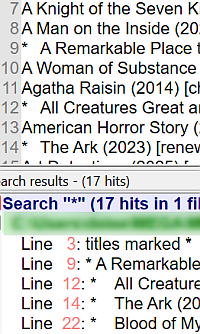
As an example, I chose to show all lines containing the the property string, with this exact case, in the ICU.txt file !
You’re perfectly right about the bug. It occurs only when the Always hide all lines and remove Show style from text before Show command option, in the Settings dialog is unchecked
After checking this option in the Setting dialog, I could easily verify, with the ICU.txt file, that the 13 green markers were there, along with the 13 lines containing the the property string
I also noted that, right after you just show these 13 lines, clicking in the margin right below the line 1183 just displays the remaining lines of the ICU.txt file ! I think that behavior is normal because if you then click on the marker of the 1183 line, it then also displays all lines between lines 1164 and 1183.
Moreover, if after showing these 13 lines, in the ICU.txt file, you switch to an other tab, then switch back to the ICU.txt file, this time, it also displays a triangular green marker in the last line 2132 of the file !
Finally, as you said, I could verify that the markers :
Were not restored at all after a click on the Reset button which follows a click on the Expand button
Were not completly restored after a click on the Reset button which follows a click on the Expand before or Expand after button
Were correctly preserved if you immediately click on the Reset button
However, the Show only lines with shown text in the Tools dialog seem to work properly, even after switching tabs : lines to show and markers seem preserved !
Best Regards,
guy038